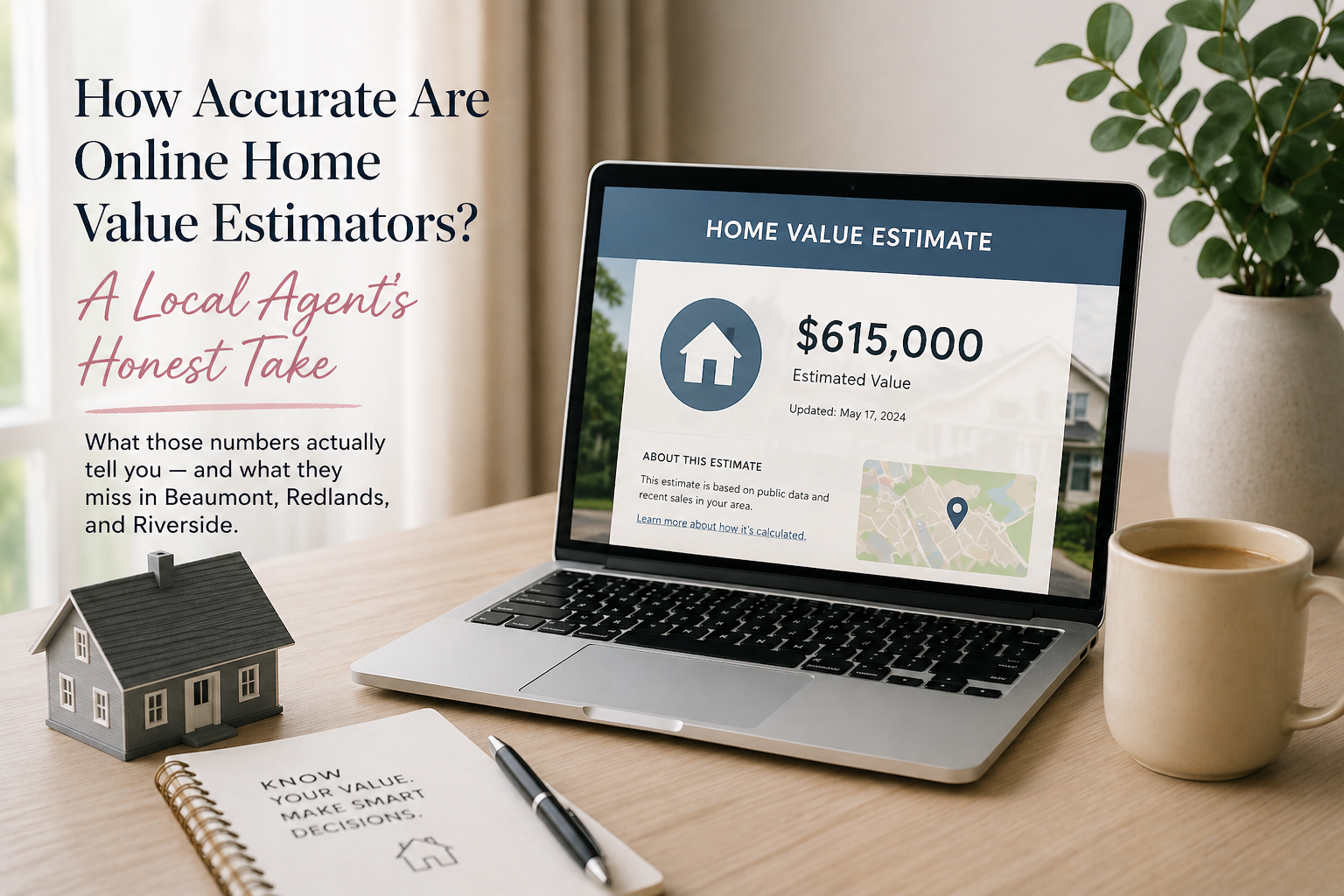
How Accurate Are Online Home Value Estimators? A Local Agent’s Honest Take
By DeBonis Team · Published April 28, 2026
If you’ve ever typed your address into Zillow on a slow Tuesday, this article is for you. Here’s what those numbers actually tell you — and what they miss in Beaumont, Redlands, and Riverside.
Almost every conversation we have with a homeowner thinking about selling starts the same way: “So I checked Zillow, and it says my house is worth…” That moment is so universal it’s almost a rite of passage. The estimate flashes on screen, your eyebrows go up or down, and suddenly you’re either calling a contractor about that bathroom remodel or worrying you waited too long to sell.
Online home value estimators — also called Automated Valuation Models, or AVMs — have changed the way homeowners think about their biggest asset. They’ve made information accessible, fast, and free. But here’s what most articles won’t tell you: they’re a starting point, not a finish line. And in markets like Beaumont, Redlands, and Riverside, the gap between an automated estimate and a real-world selling price can be tens of thousands of dollars in either direction.
This article is our honest take, after 20 Years of Real Estate Experience and 300+ closed transactions in these markets, on what these tools do well, where they fall short, and how to use them as one piece of a smarter selling decision.
The Basics
What an Automated Home Valuation Actually Is
An Automated Valuation Model is a software algorithm that estimates a home’s value by pulling from public records, recent sales data, tax assessments, and listing information. It compares your property to others nearby that have sold recently, weights those comparisons against features like square footage and bedroom count, and spits out a number.
The major players — Zillow’s Zestimate, Redfin Estimate, Realtor.com — each use slightly different data and slightly different math, which is why you’ll often see three different numbers for the same house. Our own home value tool actually pulls from multiple data sources to give you a more rounded snapshot rather than a single algorithm’s guess.
All of this happens in seconds, for free, with no obligation. That’s the magic — and it’s also where the limits start to show.
The Strengths
Where Online Home Value Estimators Actually Get It Right
Let’s give credit where it’s due. Online valuation tools are genuinely useful for several things:
- Tracking your home’s general trajectory. If you watch the estimate over six or twelve months, the direction it moves is usually accurate — even if the exact number isn’t.
- Getting a ballpark before you start planning. If you’re a year or two from selling and you just want a sense of whether you’re sitting on $400K or $800K of equity, an AVM gets you in the right neighborhood.
- Spotting market shifts. When the broader Beaumont, Redlands, or Riverside market moves, the estimates move with it. They’re a decent proxy for “what’s happening out there.”
- Cookie-cutter tract homes. The more your house looks like every other house on the block — same builder, same floor plan, same upgrades — the more accurate the estimate gets. Tract communities with steady turnover are where AVMs are at their best.
For a fast, free, no-strings-attached starting point, that’s a lot of value. The trouble starts when homeowners treat the number as the answer instead of the first question.
The Limits
Where Automated Valuations Miss the Mark in Our Markets
Here’s where 20 Years of Real Estate Experience in Beaumont, Redlands, and Riverside has taught us to be careful. Automated tools struggle most where local nuance matters most — and our markets have a lot of nuance.
Beaumont’s 55+ Communities
Take a home in Four Seasons, Solera at Oak Valley Greens, Altis, or Sun Lakes Country Club. On paper, it might look identical to a similar-sized home in Sundance or Tournament Hills just down the road. The AVM doesn’t always know that one is age-restricted with a $300+ monthly HOA, a private clubhouse, golf access, and a buyer pool of 55+ retirees, while the other is a family neighborhood. Those are completely different markets with completely different price drivers — and the estimator can blur them together. We’ve seen Beaumont 55+ homes come back $40,000–$70,000 off the real market value because the algorithm didn’t weight the lifestyle premium correctly.
Redlands’ Historic Charm Premium
Redlands is one of the trickiest markets in the Inland Empire for an algorithm to read. A 1925 Craftsman near downtown with original built-ins, mature citrus, and walkability to the Mission Gables doesn’t compare cleanly to a 2005 build off Lugonia. Charm, lot trees, original woodwork, and proximity to the historic core can add tens of thousands to the right home — but those factors don’t show up in tax records. AVMs lean on square footage and year built, and Redlands sellers consistently get under-quoted because of it. The opposite is also true: a tired 1970s ranch in a less-loved pocket might come back too high if the algorithm leans on glossier comps from the historic district.
Riverside’s Neighborhood-by-Neighborhood Variance
Riverside might be the most diverse city in our service area in terms of price-per-square-foot. The Wood Streets, Victoria, Mission Grove, La Sierra, and Canyon Crest are five completely different markets — and that’s before you get to Orangecrest or Woodcrest. AVMs that pull comparable sales from a wider radius can drag your estimate up or down based on neighborhoods that have nothing to do with your block. Luc grew up in Riverside, raised his kids there, and started this business there, and the difference between a “Riverside comp” and a real comp is something you only learn by walking these neighborhoods for years.
What Algorithms Can’t See
Beyond the geography, here’s a non-exhaustive list of things AVMs typically miss: condition and updates inside the home, the quality of a remodel versus the existence of one, view, lot orientation, school boundary precision, noise from a nearby road, deferred maintenance, the energy of the neighborhood, current buyer demand, and whether your specific street gets multiple offers or sits for 60 days. These are the things buyers actually pay for — or refuse to pay for — when they walk through your door.
Two Tools, Two Jobs
AVM vs. CMA: When Each One Is the Right Tool
There are really two tools in a homeowner’s toolkit when it comes to figuring out what your house is worth, and they’re built for different jobs.
The AVM (Automated Valuation Model)
Best for: getting a quick, no-pressure baseline. Tracking your equity over time. Deciding whether it’s worth a deeper conversation. The AVM is the right tool when you’re early — months or years from listing — and you just want a sense of where things stand.
The CMA (Comparative Market Analysis)
Best for: deciding what to actually list at. A CMA is what an experienced local agent puts together by hand — pulling true comparable sales from your specific neighborhood, walking through your home (or reviewing photos and a thorough condition conversation), factoring in current buyer demand, and adjusting for the specific things that make your property unique. It’s the difference between an algorithm guessing and a human who has sold homes on your street making a recommendation. A CMA is the right tool when you’re 90 days or fewer from making a real decision.
Both have their place. The mistake most homeowners make is trying to use the wrong tool for the wrong job — listing based on a Zestimate, or skipping the AVM entirely when they’re just trying to track their equity year over year.
The Smart Approach
How Smart Sellers Use Both Tools Together
If you’re thinking about selling in the next 12 months, here’s the playbook we recommend:
- Start with our home value tool. Get a baseline estimate. Watch it for a few weeks or months and notice the trajectory. This costs you nothing and commits you to nothing.
- Pay attention to the comps the tool surfaces. Are those homes really like yours? Are they on streets you’d consider equivalent? This gives you a sense of how much trust to put in the number.
- When you’re 60–90 days out, request a real CMA. A walk-through, a real conversation about your home’s condition, your timeline, and your goals — and a number that reflects what your home will actually sell for in today’s market, not last year’s.
- Make your decision with both numbers in front of you. If they’re close, that’s a strong signal. If they’re far apart, the gap usually points to something specific about your home or street that the algorithm couldn’t see — and that’s information worth understanding before you list.
Buyers, by the way, do exactly this. The best ones come to showings already knowing the AVM number, the recent street comps, and what your home offers that those comps didn’t. Sellers who walk in with the same information are almost impossible to take advantage of — and that’s the position we want every one of our clients in.
Where We Work
Find Your Home’s Value in Your City
We’ve built dedicated home value pages for every city we serve, with local market context that goes well beyond what a national tool can tell you. Each one combines the speed of an automated estimate with the local knowledge that algorithms simply don’t have:
- Beaumont home values — Where Luc and Stephenie live and work daily
- Redlands home values — Home of our office and the historic district specialist
- Riverside home values — Where Luc and Stephenie grew up and started this business
- Banning home values
- Yucaipa home values
- Calimesa home values
- Moreno Valley home values
- Hemet home values
- San Jacinto home values
If you’re already running the numbers on a potential next move, our mortgage calculator is a good companion piece — same idea: a fast, accurate estimate to help you make a smarter plan.
Ready When You Are
Get the number — then get the plan.
Start with our home value tool for an instant estimate, or skip ahead and request a real Comparative Market Analysis from our team. No pressure, no obligation, no spam — just a clear picture of where you stand.