
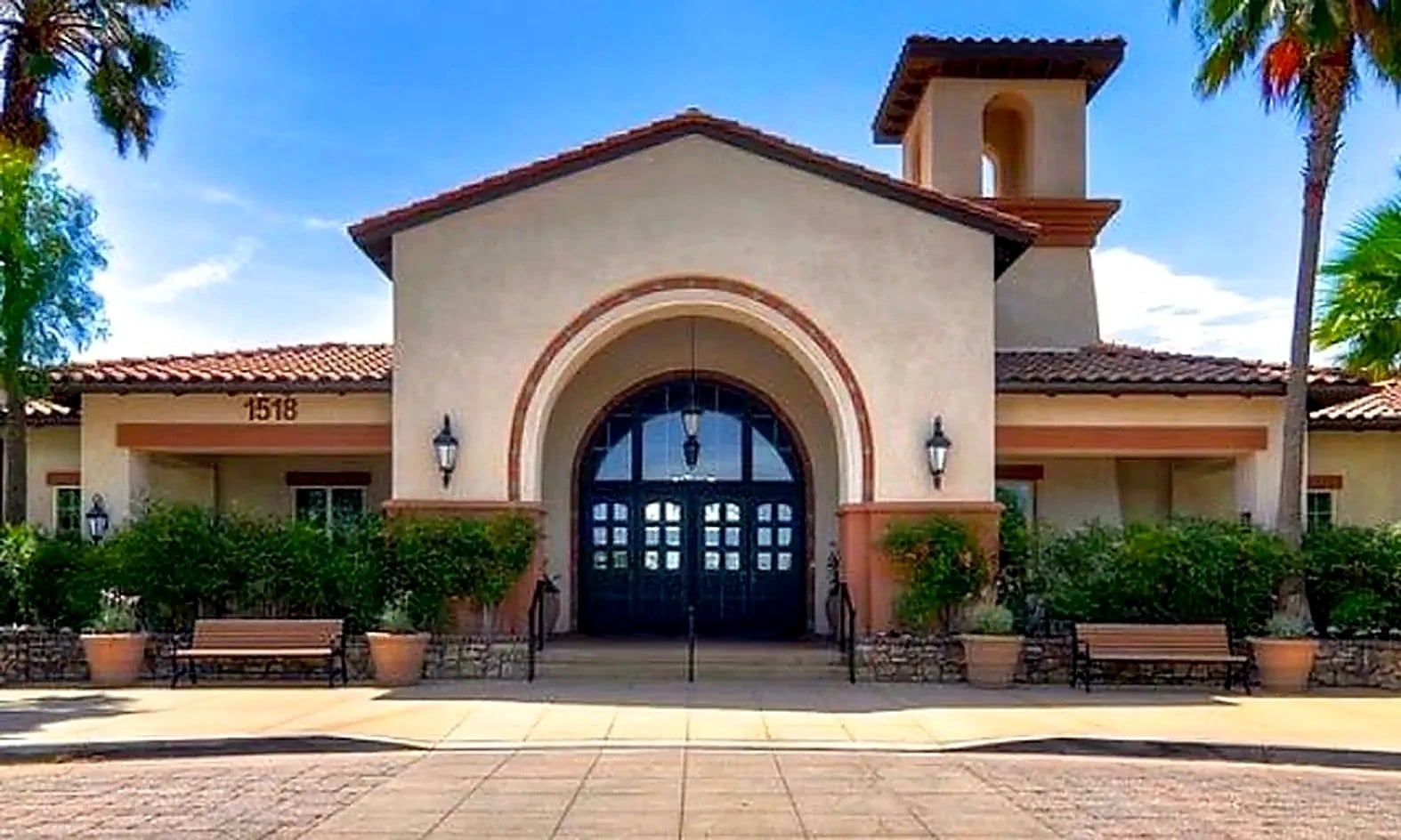
Four Seasons at Beaumont CA: What Buyers and Sellers Should Know
By DeBonis Team · Published August 2, 2026
Four Seasons at Beaumont is a gated, age-restricted (55+) active adult community of 1,923 homes on roughly 500 acres, built by K. Hovnanian between 2005 and 2019. It is fully built out, so every purchase is a resale, and build year, floor plan collection and the condition of the individual home drive price. The community runs three separate recreation facilities (The Lodge, The Summit and The Courts), and the master HOA assessment is $321 per month as published here, so confirm the current figure in writing before you buy or price. Public price-per-square-foot data lands around $220–$230 (a July 2026 snapshot).
It is also the one people most often misunderstand. Buyers tour one clubhouse, assume they have seen the community, and make a decision on a third of the picture. Sellers price against a neighbor’s sale without accounting for which collection their home belongs to or which facility they live near. Both are expensive mistakes, and both are avoidable.
What Is Four Seasons at Beaumont?
Four Seasons at Beaumont is a gated, age-restricted (55+) active adult community built by K. Hovnanian, the builder behind the national Four Seasons brand. Construction ran from 2005 through 2019, and the community was built out to 1,923 homes across roughly 500 acres.
That build-out timeline matters more than most buyers realize. A home finished in 2006 and a home finished in 2018 sit inside the same gates and share the same HOA, but they are different products — different floor plan collections, different construction standards, different levels of updating. When you see two Four Seasons homes with similar square footage and a meaningful price gap, the build year is usually part of the answer.
Because the community is fully built out, there is no builder inventory. Every purchase is a resale, which means the condition and updates of the individual home carry more weight here than in a community still selling new construction.
The Homes: Collections, Sizes, and What Drives Price
K. Hovnanian built Four Seasons in named floor plan collections rather than one uniform product line. The collections include Springdale, Colonnade, Monarch, Arbors, Keystone, Heritage, Laurel, Medallion, and Landmark.
Homes are single-story, generally offering two to four bedrooms, two to three bathrooms, and two- to three-car garages. Reported square footage ranges vary by source, so treat any single published range with caution — the honest answer is that the community spans compact, low-maintenance floor plans through considerably larger homes, and the spread is wide enough that “average price per square foot in Four Seasons” is a number worth distrusting.
What actually drives price inside the gates:
- Which collection the home belongs to. Collections are not interchangeable. Buyers who have toured several quickly develop a preference, and that preference shows up in offers.
- Lot position. Backing to open space or a trail corridor is a different asset than backing to another home. This is one of the largest single swing factors and one that automated valuation models handle poorly.
- Which facility you are near. More on this below — it is a real factor, and it is one most out-of-area agents miss entirely.
- Updating. With no new construction available, a genuinely updated kitchen carries more weight than it would in a community where a buyer could simply buy new instead.
- Single-story throughout. This is the baseline expectation for the buyer pool here, not a premium feature.
How Many Facilities Does Four Seasons Have, and Why Does It Matter?
This is the single most common thing buyers get wrong about Four Seasons, and it is worth being precise about. The community operates three separate recreation facilities, each with its own amenities and its own hours.
The Lodge
The community’s largest and most active facility. According to the HOA, The Lodge houses:
- A ballroom with capacity for 365 — used for board meetings, town halls, Social Committee events, and Performing Arts Club programs, and available to residents for qualified private events
- The Bistro, an on-site restaurant with a posted menu and nightly specials
- A movie theater / screening room
- A resident-maintained lending library
- A billiards room (capacity 30)
- A craft room (seats 35) and a card room (seats 40)
- Pool and spa
- An amphitheater
- Paddle tennis courts, pickleball courts, basketball, and shuffleboard
The Summit
- Indoor pool and outdoor spa
- Lounge / social room
- Workout room
- Bocce ball courts and horseshoes
- Meditation garden and patio
The Courts
- Gym
- Locker room with sauna
- Ping pong room
- Tennis courts
- Putting green
- Dog park
- Outdoor pool and spa
Add those up and Four Seasons offers three pool areas — the Lodge pool and spa, the Summit’s indoor pool with outdoor spa, and the Courts’ outdoor pool and spa. For a buyer who swims year-round, the Summit’s indoor pool is often the detail that settles the decision, and it is the one most likely to be skipped on a quick tour.
There is also an on-site salon in addition to the Bistro.
The practical takeaway: if you tour Four Seasons and only see The Lodge, you have seen roughly a third of what you would be paying dues for. Ask to see all three. If your agent does not know there are three, that tells you something too.
What Are the HOA Dues and Taxes in Four Seasons?
The master HOA assessment is currently $321 per month. Third-party sites quote figures well above that — we have seen everything from $321 to over $500 — so take any aggregator number with caution and confirm the current figure directly.
What we will tell you is what to actually verify before you write an offer:
- The current monthly HOA assessment, confirmed from the association — not from a listing remark or an aggregator site.
- What the dues include, since access to all three facilities is a meaningful part of the value.
- Any special assessments, current or anticipated.
- Community Facilities District (CFD) / Mello-Roos obligations on the specific parcel, and how many years remain. In this part of Riverside County, CFD amounts vary parcel by parcel and materially change your monthly cost. Two nearly identical homes can carry different obligations.
That last point is where buyers get surprised most often. The mortgage payment is the easy part. The full monthly picture — payment, HOA, and CFD together — is the number that determines whether a home actually fits, and it is the number we walk clients through before they fall for a floor plan.
Home Prices: What the Market Looks Like Now
The figures below are a rough public-data snapshot from July 2026, not a valuation. We will replace them with our own MLS numbers.
The most dependable public figure is price per square foot, at roughly $220 to $230. Two independent sources land within about four percent of each other there, which is as close to agreement as third-party data gets.
Sale prices are a wider story. Redfin reports a median sale price near $534,000 — but on only three closings, which is far too thin to lean on. Movoto shows a median list price of about $424,000 across roughly 34 to 52 active listings. Published price ranges for the community run from about $300,000 to $700,000.
Those numbers are not in conflict so much as measuring different things — one counts what closed, the other what is currently asking. Days on market shows the same split: 27 days against Redfin’s sold data, versus 137 days of accumulated listing age on Movoto. Neither figure is wrong. They simply answer different questions, and quoting either one alone would mislead you.
Use the range above for orientation. Use a real comparable-sales analysis for a decision.
A word on why we would rather leave this blank than guess: Four Seasons spans nearly 2,000 homes built across fourteen years in nine different collections. A citywide Beaumont median tells you almost nothing about what your specific home is worth, and an algorithm that cannot see your lot position or which collection you are in will not either. Real numbers come from comparable sales inside the gates, adjusted for the factors above.
Where Four Seasons Actually Sits
Location is doing more work here than most listings let on, and it is worth understanding before you compare Beaumont against the desert communities an hour east.
Four Seasons sits in the San Gorgonio Pass — the corridor between the San Bernardino Mountains to the north and the San Jacinto Mountains to the south. The summit of that pass is in Beaumont itself, at roughly 2,600 feet, just east of where Interstate 10 meets State Route 79.
That elevation is the whole story climatically. The pass is a transitional zone: Mediterranean climate to the west, desert climate to the east. Beaumont sits on the cooler side of that transition. For a buyer weighing Four Seasons against a 55+ community down in the Coachella Valley, that difference in summer temperature is usually the deciding factor, and it is the one people underestimate until they have spent a July in both.
Two honest counterpoints, because you will notice them anyway:
- It is windy. The pass is one of the windiest places in the country — that is why the wind farms are there. Most residents stop noticing. Some never do.
- It snows. Lightly, usually once or twice a winter, and it rarely sticks to pavement. If you are picturing year-round desert warmth, this is not that.
The trade for that is real: cooler summers, actual seasons, and mountains on both horizons. Plenty of buyers move here specifically to get out of the heat further east.
Living There: Rules, Gates, and the Things Nobody Mentions on a Tour
Four Seasons is guard-gated, and guest access runs through a registered visitor system — so friends and family are logged in rather than waved through. Most residents consider that a feature. If you host often, it is worth knowing how it works before you move in.
The community is professionally managed rather than run by volunteers alone, and it has an active Architectural Review Committee. That committee maintains an approved exterior color matrix, and exterior changes go through a submission process. This matters in both directions:
- If you are buying: the streetscape stays consistent, and your neighbor cannot paint their house whatever they like. That consistency is part of what protects value in a community of nearly 2,000 homes.
- If you are selling: unpermitted exterior changes made by a previous owner can surface at the worst possible moment. Worth checking before you list, not during escrow.
None of this is unusual for a community of this size and quality. It only becomes a problem when nobody tells you about it until you are already in contract.
Who Is Four Seasons a Good Fit For, and Who Isn’t It?
We would rather you land in the right community than simply buy something from us. So here is the honest version.
Four Seasons is likely right for you if:
- You want the widest possible activity calendar and a social structure that has had two decades to develop
- You want resort-style amenities but have no interest in paying toward private golf you will not use
- Single-story, low-maintenance living is non-negotiable
- You like the idea of three separate facilities rather than one shared clubhouse
- You are comfortable buying a resale and judging homes on condition
Look elsewhere first if:
- You want brand-new construction. Four Seasons finished building in 2019. Altis is the newer option.
- Private golf on-site is central to your life. Sun Lakes is built around two courses; Four Seasons is not.
- You want something smaller and quieter. Nearly 2,000 homes is a lot of community. Solera is more contained.
- HOA oversight bothers you. The architectural rules are real and they are enforced.
That last point is worth sitting with. Some people find the structure reassuring and some find it constraining, and there is no wrong answer — but it is much cheaper to figure out which one you are before you buy than after.
How Four Seasons Compares to Other 55+ Communities Nearby
Four Seasons vs. Solera at Oak Valley Greens
Solera is a Del Webb community set alongside the Oak Valley golf area, with a resident clubhouse and single-level homes. It is smaller and more contained than Four Seasons. Buyers who find Four Seasons too large — and some do — often land at Solera. Buyers who want the widest possible activity calendar usually go the other way.
Four Seasons vs. Altis
Altis is Beaumont’s newer 55+ community, built by Tri Pointe Homes, with contemporary single-story homes and a modern amenity center. If you want newer construction and current design, Altis is the natural comparison. Four Seasons answers back with scale, three facilities, and a two-decade-deep club and social structure that a newer community simply has not had time to build.
Four Seasons vs. Sun Lakes Country Club
Sun Lakes is the other heavyweight in the area — larger still, with two private 18-hole golf courses, three clubhouses, and more than 70 resident clubs. The clearest dividing line is golf. If private golf on-site is central to how you want to live, Sun Lakes is built around it. If you would rather not pay for a golf infrastructure you will not use, Four Seasons gives you resort-style amenities without it.
Buying in Four Seasons: What to Know First
Tour all three facilities. Not one. Three. Ask about hours, because they are set by the association and can shape your routine more than you would expect.
Get the full monthly number before you fall in love. Payment plus HOA plus CFD. We put this in writing for our clients before showings, not after.
Learn the collections. Knowing that you prefer a Heritage layout to a Monarch changes what you tour and stops you wasting weekends on homes that were never going to work.
Pay attention to what is behind the house. Open space, trail corridor, or neighbor’s wall — that difference follows you for as long as you own the home, and it follows the price when you sell.
Understand you are buying resale. Build year and updating carry real weight when no new construction is available as an alternative.
Selling in Four Seasons: What Gets Your Home Sold
Price against your collection, not the community. A community-wide average will either leave money on the table or park your listing on the market. Comparable sales within your collection, adjusted for lot and condition, are the only honest starting point.
Market the facility your home sits near. A home a short walk from the Summit’s indoor pool has a specific buyer. Generic listing copy never reaches them.
Know your buyer. Four Seasons buyers are experienced, deliberate, and usually comparing three or four communities at once. They are not in a hurry and they do not respond to pressure. They respond to straight answers.
Have the HOA and CFD numbers ready on day one. Deals stall when this information surfaces late in escrow. Getting ahead of it protects your timeline.
Presentation counts more in a resale-only community. Your competition is not a builder’s model home — it is the other resale down the street. That is a contest you can win with preparation.
Talk to a Team That Actually Knows These Communities
Four Seasons, Solera, Altis, and Sun Lakes each suit a different person, and the honest answer to “which one is right for me” depends on details no website can tell you. That is a conversation, not a search result.
The DeBonis Real Estate Team is a family team rooted in Beaumont, and 55+ communities are a core part of what we do. We will give you the real numbers for your situation and a clear plan — whether you are buying, selling, or still deciding whether the move makes sense at all.
No pressure. No obligation. No sales call unless you want one.
Common Questions About Four Seasons at Beaumont
How many homes are in Four Seasons at Beaumont?
1,923. K. Hovnanian built the community between 2005 and 2019, and it is now fully built out — which means there is no builder inventory and every purchase is a resale.
How many clubhouses does Four Seasons at Beaumont have?
Three. The Lodge is the largest, with a ballroom, the Bistro restaurant, a movie theater, a library, billiards, craft and card rooms, and a pool and spa. The Summit adds an indoor pool with an outdoor spa, a workout room, bocce courts, and a meditation garden. The Courts has a gym, a locker room with sauna, tennis courts, a putting green, and a third outdoor pool. A buyer who tours only The Lodge has seen about a third of what their dues cover.
What is the HOA fee at Four Seasons at Beaumont?
The master HOA assessment is currently $321 per month. Several third-party sites quote considerably higher figures, so confirm the current number directly with the association before writing an offer. Ask what the dues include, since access to all three facilities is a meaningful part of the value, and ask about any current or anticipated special assessments.
Does Four Seasons at Beaumont have Mello-Roos?
Yes. Four Seasons sits within the Beaumont Community Facilities District, so homes carry a Mello-Roos special tax on top of the base property tax. This is standard across the planned communities in Beaumont and is disclosed at close of escrow. Amounts vary parcel by parcel, and some resale listings advertise Mello-Roos paid in full — worth asking about specifically.
Is Four Seasons at Beaumont gated?
Yes. The community is guard-gated, with guest access handled through a registered visitor system. It is also age-restricted: at least one resident must be 55 or older.
Information in this post is deemed reliable but not guaranteed. Community details, HOA fees, pricing, and market data are subject to change. Buyers and sellers are encouraged to independently verify all information through the appropriate HOA, escrow, and real estate professionals prior to making any real estate decision.